How Centralized AI Models Train Your Competitors
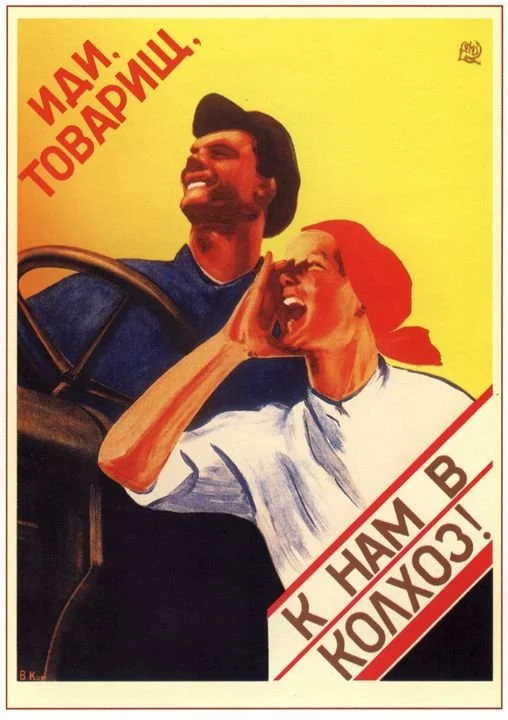
Idi, tovarishch, k nam v kolkhoz! V.S Korableva (1930).
Last week, through a series of comments and posts, I introduced one of BomaliQ's diagnostic frameworks, and it didn't just ruffle feathers—it sent several C-Suite leaders into a tailspin: AI agent platforms are a resurrection of the Kolkhoz, a new form of AI Communism.
Before I share the full BomaliQ analysis grid, I urge every C-Suite leader to consider the following facts:
𝗧𝗵𝗲 𝗰𝗮𝗽𝗶𝘁𝗮𝗹𝗶𝘀𝘁 𝗳𝗼𝗼𝗱 𝗰𝗵𝗮𝗶𝗻 𝗵𝗮𝘀 𝗲𝘃𝗼𝗹𝘃𝗲𝗱, and you are no longer at the top. Your predator is the one who holds the cloud and the computational power.
𝗬𝗼𝘂𝗿 𝗻𝗲𝗼𝗹𝗶𝗯𝗲𝗿𝗮𝗹 𝗶𝗱𝗲𝗼𝗹𝗼𝗴𝘆 𝗶𝘀 𝗯𝗹𝗶𝗻𝗱𝗶𝗻𝗴 𝘆𝗼𝘂, and it will not protect you. The new predators do not play by the rules of free and self-regulating markets; they use the methods of a centrally planned economy, mirroring the Soviet Union’s Communist Party. You are no longer operating in the same reality.
𝗧𝗵𝗲 𝗨𝗦 𝗴𝗼𝘃𝗲𝗿𝗻𝗺𝗲𝗻𝘁 𝘄𝗶𝗹𝗹 𝗻𝗼𝘁 𝘀𝗮𝘃𝗲 𝘆𝗼𝘂—quite the opposite. Look at Uttech and towns across the country: the government is leveraging its most aggressive tools of state control (legal authority) to seize private property for public use, all to support the expansion of privately owned AI data centers. It is a perfect illustration of the AI Communism stack—a direct lift from the Soviet playbook of centralized extraction.
Competition is everything in the neoliberal ideology. While the Milan-Cortina Winter Olympics wrapped up just a few days ago, the lesson remains: in any competition, there is only one spot for the gold medal. Disclaimer: If you continue to transform your firm into a Kolkhoz, that gold medal will not be yours.
A kolkhoz was a form of collective farm in the Soviet Union where peasants pooled land and equipment to work on state-owned land, sharing profits based on labour. These farms were central to Soviet agricultural collectivization, often with members keeping small private plots for personal use. Ironically, AI-powered platforms operate along the same logic.
𝗧𝗵𝗲 𝗦𝗶𝗹𝗶𝗰𝗼𝗻 𝗞𝗼𝗹𝗸𝗵𝗼𝘇: 𝟲 𝗦𝘁𝗿𝘂𝗰𝘁𝘂𝗿𝗮𝗹 𝗥𝗶𝘀𝗸𝘀 𝘁𝗼 𝗬𝗼𝘂𝗿 𝗦𝗼𝘃𝗲𝗿𝗲𝗶𝗴𝗻𝘁𝘆
1. Quota vs. Quality
Soviet Kolkhoz: Arbitrary production targets set by the Center, ignoring actual utility. Success was measured by arbitrary tonnage reports sent to the Center, regardless of whether the grain was rotting or the soil was dying.
AI-Powered Platform: High-volume generation of code, text, and data. Success is sold as "10x content generation," flooding the organization with high-volume outputs that often lack strategic utility or accuracy.
Are you measuring ROI based on the volume of AI-generated noise, or on the resolution of your most complex business bottlenecks?
2. Knowledge Transfer
Soviet Kolkhoz: Farming techniques from Kolkhoz A are immediately seized, centralized, and redistributed to dictate production standards in Kolkhoz B.
AI-Powered Platform: Your proprietary prompts and unique business context are ingested to optimize the model’s performance for the next user—your competitor.
Are you comfortable knowing your strategic "secret sauce" is effectively training your rival’s future autopilot?
3. Skill Loss
Soviet Kolkhoz: Farmers were forced to abandon ancestral expertise to follow a centralized, generic instruction manual, thereby killing local adaptability.
AI-Powered Platform: Managers lose their critical-thinking muscle through over-reliance on model outputs and outsourcing judgment to models, leading to systemic decisional atrophy.
If your AI provider went dark for 48 hours, would your leadership team still possess the autonomous muscle memory to navigate a crisis?
4. Progress Illusion
Soviet Kolkhoz: On paper, industrialization showed massive progress; in reality, the lack of local ownership led to systemic fragility and eventual collapse.
AI-Powered Platform: Short-term productivity spikes mask long-term model collapse and the exhaustion of the company’s original creative “soil.”
Is your current efficiency gain building a lasting asset, or are you just burning your strategic capital for a temporary speed boost?
5. Tool Ownership
Soviet Kolkhoz: The State owned the tractors and the land; the worker was a tenant with zero equity in the means of production.
AI-Powered Platform: The Vendor owns the weights, the compute, and the logic; your firm is a precarious renter of its own value.
If your vendor pivots their pricing or terms, do you have a Plan B that doesn't involve rebuilding your entire decision-making chain from scratch?
6. Input vs. ROI
Soviet Kolkhoz: The peasant provided 100% of the labour; the State kept 90% of the harvest for central distribution.
AI-Powered Platform: You provide 100% of the data and industry expertise; the Vendor captures the compounding value of the intellectual asset.
Who is the primary beneficiary of your data’s refinement: your shareholders, or the valuation of your AI provider?
The Bottom line
By deploying off-the-shelf AI agents, you are effectively pouring your strategic intelligence into a communal pot. This is the Kolkhoz principle: you provide the backbreaking labour to improve the land you do not own, only to see the harvest used to feed your competitors tomorrow.
The market sells the C-Suite autonomous agents, but the reality is the creation of a new class of digital serfs. Your employees aren’t piloting AI; they are feeding the beast through relentless micro-validation tasks. It is a high-tech Taylorism that atrophies critical thinking muscle, leading to terminal decisional exhaustion.
In the Kolkhoz, the gap between the peasant’s energy and the grain he was allowed to keep was abyssal. With AI, your firm provides 100% of the business context—the actual value—but receives only a standardized interface in return. The platform owner, not you, captures 90% of the marginal profit from the intelligence generated.
Pick your side: Are you a socialist leader or a blind capitalist?
There are two ways to look at your current AI strategy:
You are a secret believer in collective wealth. You happily pool your most valuable assets—data, proprietary processes, and C-Suite expertise—into a central platform, knowing they will be redistributed to improve your competitors' performance.
You claim to be a capitalist defender of intellectual property, yet you are currently handing over your unique competitive edge to a platform vendor for a 10% speed boost.
Either way, you are bleeding.
So, what?
At BomaliQ, we independently audit your sovereignty reality.
To stop bleeding and reclaim your competitive edge, we offer two levels of intervention:
The BomaliQ Sovereign Stress Test: Before you scale your Kolkhoz, we perform a high-velocity stress test. We identify exactly where your proprietary intelligence is leaking into the communal pot and quantify your current level of dependence on platform predators. Get a clear map of your algorithmic liabilities before your next board meeting.
The BomaliQ Quarterly Diagnostic: For organizations that refuse to be digital serfs, we provide a systemic, quarterly mapping of your AI risks. We evaluate every friction point, measure your decisional exhaustion levels, and deliver actionable, non-negotiable solutions to keep your sovereignty intact. Actionable roadmaps. Systemic risk mitigation. Limited to 100 decision-making units per quarter.
About the Author & BomaliQ
This newsletter is authored by Mathieu Lajante, PhD, Founder and Architect of BomaliQ Inc. BomaliQ provides specialized strategic intelligence for the algorithmic frontline, helping corporate leaders navigate the behavioural and political frictions of high-tech organizational transformation.
Nature of Intelligence
The insights provided in this publication are based on the stress-testing of publicly available industry reports, market data, and proprietary analytical frameworks. This content is intended for informational and strategic signalling purposes only. While every effort is made to ensure the accuracy of the analysis, the algorithmic frontline is a volatile environment.
Limitation of Liability
The BomaliQ Risk Signal does not constitute professional consulting advice, legal counsel, or a formal business diagnosis. Readers should not make critical strategic decisions based solely on this newsletter without a rigorous, organization-specific assessment. BomaliQ Inc. and Mathieu Lajante shall not be held liable for any business outcomes or losses resulting from the use of this general intelligence.