The Silicon Kolkhoz: A Corporate Platformization Audit Framework
Big Tech pitches AI as a plug-and-play tool designed to accelerate corporate value; the operational reality tells a different story. AI was supposed to fit into corporations’ workflows, but we observe the opposite: corporations now scramble to adapt their workflows, human capital management, and organizational cultures to fit the top-down architectures of third-party agentic platforms.
At BomaliQ, we ground this technological shift in the historical reality of Soviet agricultural collectivization (the kolkhoz) to propose a critical framework, the Silicon Kolkhoz, that exposes the hidden political economy of modern corporate technology and challenges the marketing narrative surrounding AI and corporate platformization.

El Lissitzky, Painting symbols of a new world (1920). A century ago, the avant-garde constructivist movement celebrated absolute geometry as the dawn of a liberating, collective utopia for a "new man." Today, Big Tech infrastructure appropriates these exact clean lines and mechanical abstractions to build the Silicon Kolkhoz: an invisible, algorithmic collectivization of human capital in which predictive platforms have quietly replaced the five-year plans.
The illusion of the separability of advantages and risks
Look closely at how AI and corporate platformization are presented to your executive boards today.
On the one hand, the advantages are listed first, accompanied by an unshakeable assertion that credits the organization for its foresight strategy: promising infinite scalability, immediate headcount reduction, and flawless optimization. On the other hand, the risks are kept in a separate box and are blamed on individuals. The tone immediately shifts to a patronizing style of corporate caretaking, which sounds less like an industrial risk assessment and more like: “Have fun, kiddos! But don’t eat too much candy!“
This structural separation is a managerial illusion, a rhetorical sleight of hand that asserts the agentic platforms’ advantages are an anchored reality, while the risks live independently in a distant sphere, as if the risks were merely a forbidden fruit you could simply choose not to touch while still enjoying the rest of the garden.
The material reality is dialectic. The risks of platformization are not accidental side effects; they are the sine qua non condition of the platform’s efficiency.
What Big Tech markets as an advantage of optimization is structurally fueled by what they classify as a disadvantage on the other side of the ledger: the extraction of your proprietary data, panoptic surveillance of your workforce, and the erosion of your corporate sovereignty. Neither can exist without the other.
Once you pierce this patronizing rhetoric and confront this dialectical reality, you realize that while you are being sold a plug-and-play tool, you surrender your corporate autonomy to a centralized architecture of extraction.
Welcome to the Silicon Kolkhoz.
The historical parallel
To understand the strategic utility of the Silicon Kolkhoz, one must look at the structural mechanics of the original Soviet model:
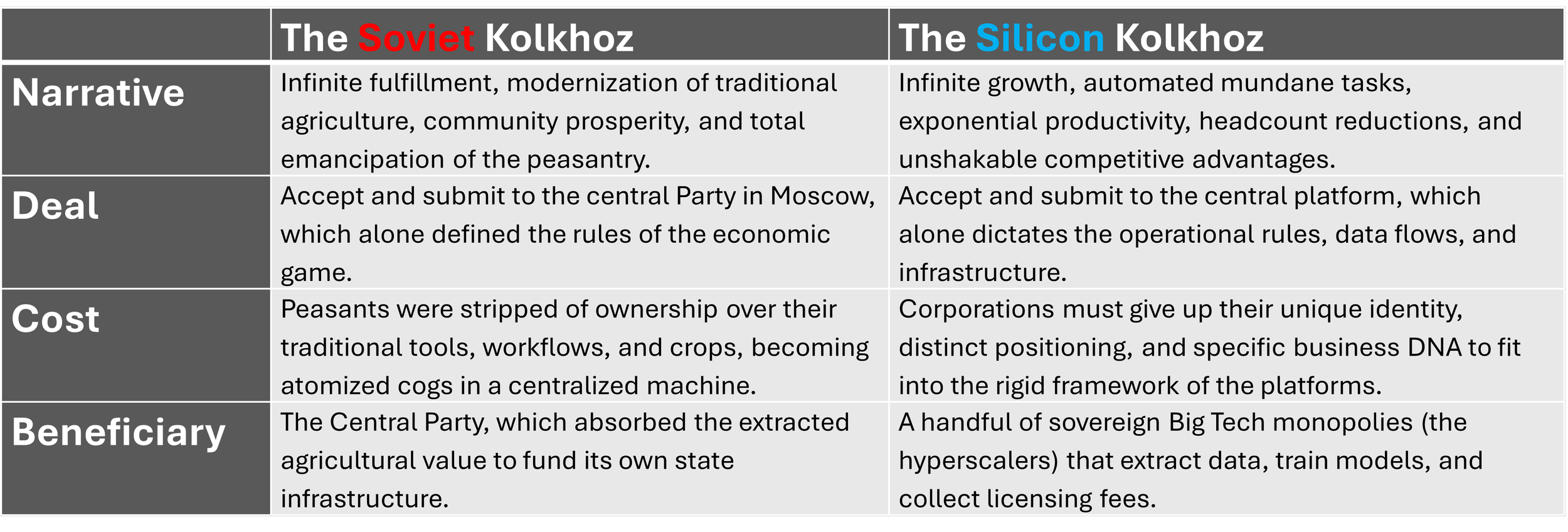
The preliminary symptoms of corporate platformization
Just as the early stages of agricultural collectivization signalled a systemic erosion of agricultural sovereignty and local knowledge, the symptoms of the Silicon Kolkhoz are already rearing their ugly heads.
The current collapse of human judgment, the visible decay of original creativity, and the impoverished style of writing and thinking driven by AI slop are preliminary structural symptoms of corporate platformization. They signal the progressive mechanization of the workforce, in which human cognitive variability is smoothed out and flattened to meet the central platform’s standardized inputs.

M. Soloviev, We will respond with valiant labor for great care! (1958). A Soviet propaganda poster of the mid-century collectivized economy: the individual worker looks toward centralized state decrees as the ultimate source of organizational "care," fulfilling the plan through machine optimization. In the modern corporate landscape, this dynamic has been digitized into the Silicon Kolkhoz. Under the guise of automation, platform architectures present algorithmic optimization as a benevolent corporate asset, while structurally demanding panoptic surveillance, extraction of workforce data, and the systematic surrender of human sovereignty.
The algorithmic frontline
Today, the physical crops of the Russian steppes have been replaced by the algorithmic frontline: the digital interfaces where employees, managers, prosumers, and platforms interact.
When a corporation integrates deeply with an AI-driven platform (whether for recruitment, logistics, or performance management), it enters a state of digital sharecropping. The platform dictates the cadence, evaluation metrics, and workflows. The human worker’s consciousness, physical body, or emotional output is converted into continuous data packets that train and optimize the platform’s proprietary algorithms.
The immediate casualty of this ecosystem is the human manager, whose strategic sovereignty is hollowed out. Management is reduced by enforcing a platform-dictated cadence that overrides localized human intuition.
Last week, Fortune reported that Cloudflare cut 20% of its workforce, bragging that “AI has made managers an entire category of workers obsolete,” and rebranding them as “measurers.” You can’t make this up.
The strategic and operational framework
Far from just an abstract historical analogy, the Silicon Kolkhoz serves as an operational and diagnostic framework used to help executives actively audit, score, and defend their corporate sovereignty. The Silicon Kolkhoz framework shifts the conversation from technical optimization (”How fast is this AI?”) to political economy and risk mitigation (”Who actually owns the value and identity of our company today?”). It equips modern leaders with the precise analytical tools needed to halt the erosion of their sovereignty and protect both their corporate independence and the human element of their workforce.
Accordingly, the framework systematically maps and monitors five critical operational risks:
Corporate independence and platform lock-in: It measures the extent to which an organization’s core operations have become reliant on rented infrastructure. If pulling the plug on a specific AI platform would collapse corporate operations, the business is no longer an independent entity; it is a digital tenant that has forfeited its autonomy to the central platform.
Human capital erosion and cognitive flattening: It tracks the psychological and behavioural damage inflicted on the workforce when forced to comply with rigid digital cadences, monitoring the erosion of human judgment, creative friction, and critical thinking in favour of automated, platform-compliant behaviour. This includes scoring invisible friction points such as quiet quitting, covert sabotage, distrust, and surveilled anxiety.
Value production and ownership displacement: It evaluates where the true intellectual property and value are stored. When corporate employees input their specialized knowledge into an AI tool to generate an output, the framework assesses how much of that long-term strategic value is retained by the corporation versus how much is extracted to optimize the vendor’s model.
The ROI stall: It diagnoses why multi-million-dollar AI implementations fail to deliver expected financial returns. The framework identifies the hidden drag that arises when employees put their values on mute or covertly hijack the system because the algorithmic workflow fundamentally clashes with their mental models.
Strategic-workforce misalignment: It highlights the structural break that occurs when a C-suite’s overarching business strategy relies on a corporate culture, identity, and unique business DNA that have been quietly crushed or mechanized by the platform's daily operational reality.
Defending corporate sovereignty
While pioneering critics such as Karen Hao expose the colonial dynamics of AI, Yanis Varoufakis theorizes techno-feudalism, and Antonio Casilli uncovers the exploitation of digital labour, their focus remains on the citizen and the worker.
The unique positioning and strategic value of BomaliQ’s Silicon Kolkhoz framework lie in a radical departure from this tradition: it takes the enterprise’s side. This requires a delicate cognitive balancing act. Today’s corporations remain blinded by the comfortable illusion that they are the undefeated champions of late-stage capitalism. They remain impervious to the idea that they could ever be reclassified as the exploited (a category they have historically misunderstood or dismissed).
And yet, the capitalist food chain is undergoing a disruptive inversion. Yesterday’s apex predators are quietly becoming today’s prey.
The platforms are not tools. They are sovereign structures designed to absorb the unique business DNA, identity, and strategic autonomy of the corporations that rent them. Those executives who can tear through the veil of tech-hype and look this material reality dead in the eye will be the ones who survive the storm. They will adapt to the new economic order that will shape global business models for decades to come.
The frontier has been drawn, and the platformization of the enterprise is already underway.
Choose your camp, comrade!
About the Author & BomaliQ
This newsletter is authored by Mathieu Lajante, PhD, Founder and Architect of BomaliQ Inc. BomaliQ provides specialized strategic intelligence for the algorithmic frontline, helping corporate leaders navigate the behavioural and political frictions of high-tech organizational transformation.
Nature of Intelligence
The insights provided in this publication are based on the stress-testing of publicly available industry reports, market data, and proprietary analytical frameworks. This content is intended for informational and strategic signalling purposes only. While every effort is made to ensure the accuracy of the analysis, the algorithmic frontline is a volatile environment.
Limitation of Liability
The BomaliQ Risk Signal does not constitute professional consulting advice, legal counsel, or a formal business diagnosis. Readers should not make critical strategic decisions based solely on this newsletter without a rigorous, organization-specific assessment. BomaliQ Inc. and Mathieu Lajante shall not be held liable for any business outcomes or losses resulting from the use of this general intelligence.