Beyond the AI Layoff Alibi
Part 1: The Exposure
The 8.4% success rate haunting the labour market is a clinical verdict on a failed experiment in the logic of human capital. Recent data shows that of every 100 companies that executed AI-driven layoffs over the past year, 91 are now drowning in the fallout. This is a concerning strategic miscalculation: the promised gains from algorithmic efficiency have vanished, leaving C-Suites to face a grim reality: more than half of these firms began rehiring for the same roles they replaced within six months, often at a significantly higher cost than the initial savings.
Meanwhile, the AI layoff has been exposed as a post hoc alibi for weak management and over-hiring, a useful fiction that sounded visionary on an earnings call but has left the HR department landlocked in a crisis of operational continuity and broken trust. The irony is now visible in the market: talented castaways are using the very skills and networks they gained at your firm to build AI-fuelled competitors, while those you attempt to rehire return as skeptics with one foot already out the door.
This systemic failure is driven, among other factors, by the verification bottleneck, a trap many leaders ignored in their rush to automate. While AI can rapidly generate cognitive outputs—writing, coding, and analysis—it introduces a reliability tax that is currently draining corporate budgets. Because these models are confidently wrong in plausible ways, humans must remain in the loop to verify every draft.
This overlooked reality is a by-design effect we diagnosed over the last three months: white-collar employees’ demotion to high-end click workers. Far from increasing efficiency, the praised “human-in-the-loop” is the click-work blueprint usually seen in BPOs of the Global South, applied to your senior talent, who slip into an expensive, invisible safety net for broken AI outputs.
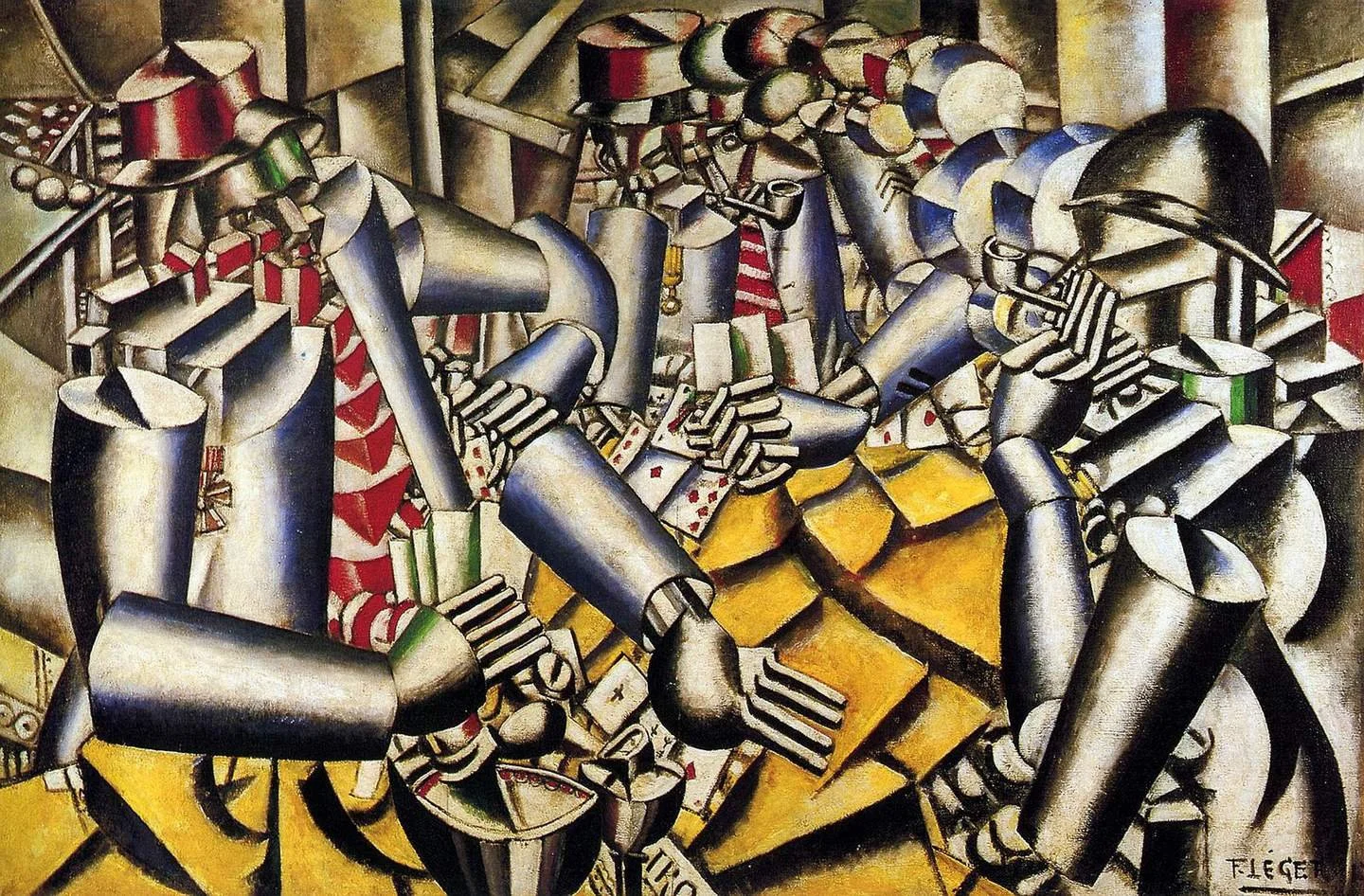
Fernand Léger’s ‘Soldiers Playing Cards’ (1917) captures the liquidation of the human into the machine—the precursor to the McDonaldized office. Just as Léger’s soldiers became metallic cylinders to survive the front, today’s C-suite risks turning elite experts into mechanized verification units within a platform infrastructure they do not own.
⏱ Reading time: 10 min | 📄 2,137 words of strategic signal | 4 friction points | 12 operational directives
When an AI promises to save time on a draft, that time is immediately offset—and often exceeded—by the time a high-salaried expert must spend reconstructing reasoning and testing claims to manage the liability of a hallucinating machine. On top of that, the tiny amount of saved time is immediately reallocated to more productive tasks, creating a mechanism of social acceleration in which workers must handle even more tasks per unit of time than usual, draining the physical and mental capital of your employees (see BRS 7 for a full diagnosis). The work has not disappeared; it has merely shifted from creative production to exhaustive supervision, creating human capital friction in which you are paying top-tier wages for what has essentially become high-stakes proofreading. While human capital leaders tend to focus on worker replacement, AI actually points to worker displacement.
You must move beyond the myth of replacement and recognize the reality of liquidated labour, in which the fundamental nature of work is displaced into a shadow labour force and a burgeoning culture of prosumerism. For decades, the Global South has provided thousands of click-workers hidden behind the curtain of automated systems, but the platformization of labour is now reaching the corporate core. Automating a role today means tethering your institutional intelligence to a third-party agentic platform—not replacing a worker with a tool. This is the Silicon Kolkhoz (see BRS 8 for the full diagnostic): a regime of digital sharecropping in which the enterprise is reduced to a mere production unit of a platform. By treating your employees as disposable assets to automate, you are inadvertently feeding your proprietary business logic and training data into the very platforms that aim to commoditize your industry.
This leads to the triple tax of vassalisation. Firms now pay a premium for the privilege of being replaced.
First, they pay escalating subscription fees and spiralling token costs on the platforms—bills that are already blowing past payroll at companies like Uber and Nvidia.
Second, they pay the tax of “micro-tasking,” in which their remaining workforce is consumed by the friction of managing platform interfaces rather than solving business problems.
Finally, they pay the tax of “free labour,” as platforms—exemplified by Meta’s recent mandatory keystroke and screenshot tracking—extract unconsented-to behavioural data from your employees to train the next generation of agentic models.
Signals of vassalisation are everywhere in the market, yet human capital leaders remain blind to this extraction-centric strategy that turns your workforce into an unpaid data-labelling operation for a third party’s benefit.
The hollowed-out firm explains why, despite the hype, AI remains invisible in macroeconomic data. Productivity, employment, and inflation figures show no significant AI bump because the technology is currently treated as a blunt cost-cutting tool rather than a sovereign asset. Boards are trading away their institutional memory and their moat of human creativity for temporary, illusory margins. When you standardize your workforce through AI-driven taskification—accelerating the McDonaldization of corporate workflows that predate AI—you make your company highly replaceable. Authentic creativity and human domain knowledge are the only true competitive edges in an automated marketplace, yet these are the very assets being systematically destroyed in the current rush toward platform dependency.
This exposure leads to a specific organizational failure.
To access the Sovereignty Protocol and the three operational lessons for this week, upgrade to Premium.
Part 2: The Diagnostic and Sovereignty Protocol
This is the premium diagnostic layer of BRS 11. If you are reading this, you have moved beyond the neoliberal and consulting BS that frames AI as a plug-and-play productivity miracle. You are here because you recognize the clinical reality: the current path leads directly to the hollowed-out firm—an organization that has traded its institutional memory and competitive moat for temporary, illusory margins.
Our objective is to transition your organization into a Frontier Firm. A Frontier Firm is defined by its strategic refusal to externalize its core logic and human intelligence. It maintains sovereignty by keeping its secret sauce off-platform, ensuring it does not become a mere production unit for a cloud provider.
The following four friction points provide the clinical “Why” and the operational “How-to” for securing your company’s survival. See you beyond the wall.
The full strategic diagnostic and operational framework is reserved for our private circle.
Access the complete BomaliQ Risk Signal below.
About the Author & BomaliQ
This newsletter is authored by Mathieu Lajante, PhD, Founder and Architect of BomaliQ Inc. BomaliQ provides specialized strategic intelligence for the algorithmic frontline, helping corporate leaders navigate the behavioural and political frictions of high-tech organizational transformation.
Nature of Intelligence
The insights provided in this publication are based on the stress-testing of publicly available industry reports, market data, and proprietary analytical frameworks. This content is intended for informational and strategic signalling purposes only. While every effort is made to ensure the accuracy of the analysis, the algorithmic frontline is a volatile environment.
Limitation of Liability
The BomaliQ Risk Signal does not constitute professional consulting advice, legal counsel, or a formal business diagnosis. Readers should not make critical strategic decisions based solely on this newsletter without a rigorous, organization-specific assessment. BomaliQ Inc. and Mathieu Lajante shall not be held liable for any business outcomes or losses resulting from the use of this general intelligence.